Signals That Mean Something on a Home Layout
Most home-layout signals are scenery pretending to work. A few rules borrowed from the real thing let them actually govern a session.
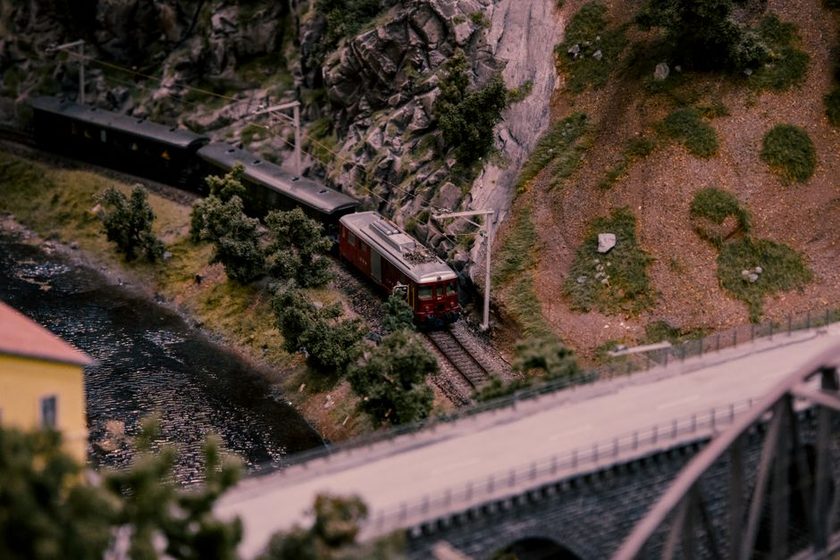
On a lot of home layouts there's a signal that has never once told anyone anything. It's usually a nice one — a scratchbuilt semaphore on a whitewood post, or a color-light head with three real LEDs wired into the layout's power bus. It sits at the end of the main line looking exactly like it should. It has also shown clear since the day it was installed, because nobody ever wrote a rule that could turn it red, and no train's movement has ever depended on what it says. It isn't a signal in any operating sense. It's a very well-built piece of scenery shaped like one. The gap between that and a signal a crew actually reads before moving isn't more LEDs or a fancier detection circuit — it's a small set of rules, borrowed mostly intact from the prototype, that decide when the aspect changes and what a crew is required to do about it.
Decoration versus authority
The prototype distinction that matters here is authority. A real signal isn't a status display; it's a standing order. A crew that passes a stop signal without one has committed a rule violation, not just missed some scenery. That's the property worth borrowing, and it's the one most home installations skip, because it's the one that costs something — it means the signal has to be capable of actually stopping a train, and it means someone has to be willing to sit at a red aspect and wait rather than fudge past it because the session is running late. A signal without that discipline behind it is decoration with a bulb in it.
What actually needs a signal
Not every turnout or curve deserves one, and trying to signal everything is how a small layout ends up with a dozen lights nobody remembers the rule for. The useful places are the ones where two moves could genuinely conflict: an interlocking where a crossing or a junction lets two routes meet, a block boundary on single track where a meet has to be managed, or the throat of a yard where a dispatcher needs the ability to hold a train out. Those are the same spots that make a headshunt worth its length rather than a formality — the signal and the point work are usually protecting the same conflict, just at different moments in the move.
A minimal ruleset that actually works
Three rules, taken more or less straight from the real thing, are enough to make a home signal mean something:
The signal governs one block, and one block holds one train's authority at a time. If a train is in the block, the signal protecting the entrance to it shows stop — automatically, by occupancy, not by an operator remembering to flip a switch. Even a crude detection method (a simple current-sensing circuit, or an honest rule that a crew reports in on a panel) beats a signal an operator sets from memory, because memory is exactly what fails under session pressure.
Absolute and permissive aspects mean different things, and both need to exist. An absolute stop means stop and stay stopped until the signal changes or someone with authority says otherwise. A permissive or restricting aspect means stop, then proceed at a crawl, prepared to stop again. Collapsing those into a single "red means go carefully" rule is how home signalling quietly becomes advisory — the two-aspect version only works if crews actually treat the absolute one as a wall.
The signal reflects the route, not the intention. A real interlocking signal can't clear until the points behind it are proven lined and locked for that route. On a home layout that means tying the signal's aspect to the actual position of the turnout — mechanically, with a microswitch on the point throw, or electrically through the same control that moves the points — so the signal can't show clear for a route that isn't physically set. A signal an operator sets independently of the points is a light that agrees with whoever's running the train, which is not the same job.
A signal that can't be wrong isn't a signal — it's a light that always agrees with whoever is running the train.
| Signal type | Prototype job | Minimal home version |
|---|---|---|
| Absolute (interlocking) signal | Denies entry to occupied or misaligned track, no discretion | Two-aspect head tied to the turnout position — red unless the points are proven correct |
| Block signal | Reports occupancy of the block ahead on a single- or double-track line | Simple detection at the block boundary driving red or green, no manual override |
| Permissive/yard signal | Allows a cautious move into a block that may already be occupied | A yellow or restricting aspect crews are told means "proceed prepared to stop," never "go" |
| Approach signal | Warns what the next signal down the line will show, so there's time to slow | A second head one block back from an absolute signal, repeating its aspect |
| Dwarf/shunting signal | Governs low-speed moves inside a yard or interlocking's limits | A ground-level head at the headshunt throat, tied to the set route rather than plain occupancy |
A quick gut check
Before wiring a single LED, write the rule on an index card: what aspect, under what condition, and what a crew is required to do about it. If you can't write that sentence, you don't have a signal yet — you have a light. Build the sentence first, then build the wiring under it.
Fitting signals into the session
Signals earn their keep fastest on the same layouts that already run from a working timetable, because the timetable is what creates the conflicts a signal exists to manage. A meet that's only a line on paper still depends on both crews reading the schedule correctly. A meet that's also backed by an absolute signal at the passing point survives a crew that reads the schedule wrong, which is closer to how the real thing behaves — the paper and the hardware are supposed to agree, and the signal is the one that can't be argued with.
Before building any signal, it's worth deciding a short list of things in advance, on paper, rather than discovering the gaps mid-session:
- Which single-track meet needs a physical signal governing it, versus one that can stay a paper meet on the timetable
- Whether the signal will be electrically interlocked to the points, or just standing nearby with its own separate control
- Who has the authority to clear a red aspect — a dispatcher at a panel, or the crew itself after a set wait
- Whether occupancy is detected automatically or self-reported honestly by the crew at a block
- How a new operator learns what each aspect means in under a minute, without a lecture
Answering those five questions before cutting any wire is usually what separates a signal that gets obeyed from one that gets glanced at and ignored by the second session.
Worth remembering
This piece describes one way of thinking about home signalling, not a standard every layout needs to meet. Plenty of well-run layouts use no powered signals at all and rely on the timetable and verbal authority instead — the aspects here are a tool for a particular kind of operation, not a requirement for a good one.